The glass cockpit
Independent and not affiliated with Cirrus Aircraft — not a Cirrus Training Center, and no training is offered here. Nothing on this page is flight instruction or a substitute for your aircraft's POH/AFM, current official documentation or an authorized instructor.
Cirrus Perspective and Perspective+ are Garmin integrated flight decks built for the airframe; the current G7 generation uses Garmin's touchscreen-controlled Perspective Touch+. Whatever the generation, the training problem is the same: the panel is not hard to operate, it is hard to stay ahead of.
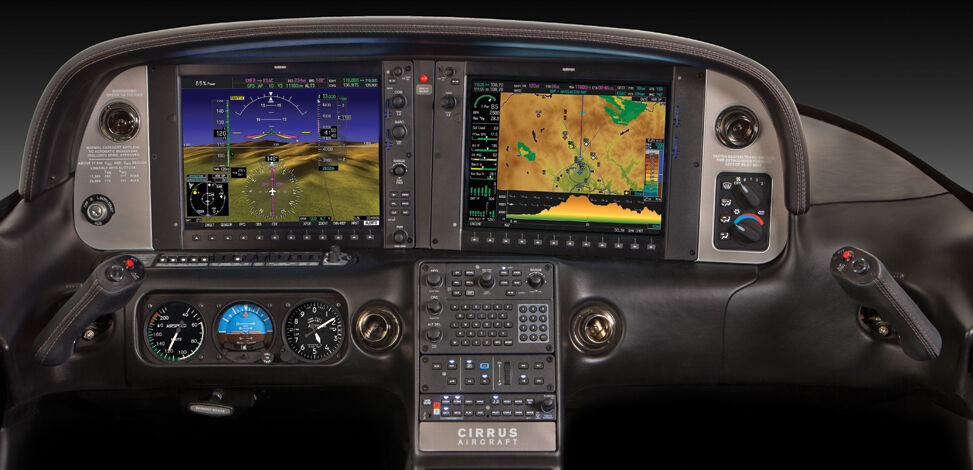

The G7 is a different machine to operate
Up to the G6, every Cirrus flight deck was a Garmin G1000 derivative: Avidyne Entegra gave way to Perspective and then Perspective+, but the way you drove the system stayed recognisably the same — softkeys along the bottom of each display, a physical keypad on the console, and knobs at the corners of the bezel. The G7, introduced in 2024, moved to the Garmin G2000 and rebranded the flight deck Perspective Touch+. That is a platform change rather than a refresh.
What a pilot notices: the softkeys are gone entirely, and nearly everything is reached through two touchscreen controllers on the console — the first piston aircraft with a pair of them, and the same interface idea the Vision Jet uses on the G3000, which is deliberate and makes a step up to the jet easier later. Displays are larger widescreen units, 12 inches as standard with 14 available. The glareshield sits lower, so there is more to see over the nose. The key is replaced by a push-to-start button, and the side yoke carries a haptic stall warning that shakes rather than only sounding. The G7+ adds emergency autoland and an emergency autothrottle as standard.
The training consequence is the point of this page. Moving from a Perspective+ aircraft to a G7 is not a familiarisation flight, even though both are "a Cirrus with Garmin glass" and the logbook will show hundreds of hours on type. Every procedure you know as a sequence of physical button presses is now a sequence of taps through a menu, and the places where that bites are not the easy ones — it is amending a clearance in the air, or reconfiguring in a hurry, where the old muscle memory is fast and wrong. Budget real time with an instructor who knows the G7, and spend some of it on a procedures trainer rather than discovering the menu structure at altitude.
What transfers badly
- Heads-down time. The most common transition failing is a pilot who was perfectly safe on steam gauges spending far too long inside the box, configuring rather than flying.
- Autopilot mode confusion. Knowing which mode is armed versus active, and what the aircraft will do next, matters more than knowing every page of the MFD. Most glass-cockpit incidents are mode awareness, not button ignorance.
- Trusting the magenta line. A flight plan that loads cleanly is not necessarily the clearance you were given.
Learning it cheaply
Avionics fluency built in the air is expensive avionics fluency. Manufacturer-published courseware, PC-based trainers and a procedures trainer on the ground all cover the same ground for a fraction of the hourly cost, and most structured transition courses lean on them deliberately.
Failure modes are the point
Time spent on what the panel looks like when something is lost — a failed display, a failed AHRS, loss of air data, a partial-panel approach — is worth more than time spent on the moving map. This is also the part self-teaching reliably skips.